

What is Asset Master Data Management in CMMS?
/
read

In industrial maintenance, a well-implemented Computerized Maintenance Management System (CMMS) can dramatically improve asset reliability, reduce downtime, and optimize maintenance workflows. But no matter how powerful the software, its effectiveness depends on a critical, and often overlooked, component: asset master data, essential for any company or enterprise managing a wide range of enterprise assets. Asset master data is one example of a broader concept known as data domains, which are used to categorize and define different types of master data within an organization, such as asset, location, and supplier data.
Asset master data includes all the core information about your assets, their specifications, hierarchy, maintenance history, spare parts, and more. This is critical information for maintenance and operations. It is the foundation of your CMMS, enabling accurate maintenance scheduling, efficient inventory control, and informed decision-making. Without clean, standardized, and complete data, even the most sophisticated CMMS can fail to deliver real value. Data standardization is a key process to ensure consistency, quality, and usability of asset master data across different systems. Integrating asset master data from multiple data sources, such as ERP systems, maintenance logs, and supplier databases, is essential for building a unified and reliable dataset.
In this article, we’ll explore why asset master data is essential to CMMS success, how to structure and maintain it properly, and what benefits your organization can unlock, especially the benefit for enterprises in asset-intensive industries, by investing in data quality, from cost control to compliance, and much more.

Computerized Maintenance Management Systems
Introduction to Master Data Management
A robust master data management (MDM) strategy is key to maintaining consistent master data throughout the organization. By implementing a unified master data service, businesses can create a single, authoritative source of truth for all master data entities.
Central to any successful MDM program are strong data governance rules and data stewardship. These elements ensure that data management processes are standardized, data quality metrics are monitored, and data reconciliation processes are in place to resolve discrepancies and maintain high quality master data.
Standardizing data formats and maintaining master data across various domains, such as customer records, product information, and physical locations, enables organizations to improve operational efficiency and reduce costs.
The benefits of a well-implemented MDM solution are far-reaching. Organizations can expect improved data quality and consistency, enhanced operational efficiency, better decision-making, and increased customer satisfaction. Additionally, a strong master data management program supports regulatory compliance and provides a foundation for effective data governance.
Why Accurate Asset Master Data and Data Quality Are Essential for CMMS Reliability
The foremost reason asset master data management is pivotal in CMMS is data accuracy. Inaccurate or outdated maintenance data can lead to costly errors and inefficiencies, causing disruptions in operations. Imagine scheduling a maintenance task based on incorrect data, only to discover the asset is in perfect condition. Similarly, an incorrect address in the master data can result in shipping errors, missed service appointments, or failed deliveries, leading to customer dissatisfaction and increased operational costs. This not only wastes resources but also disrupts operations.
Asset master data guarantees the accuracy of information within the CMMS. Each asset is represented by a master data record, which serves as the authoritative entry containing essential details such as model numbers, serial numbers, and maintenance history. This master record must be kept accurate and up to date to ensure reliability and support effective maintenance practices.
Regularly updating asset master data is essential to incorporate new data from recent maintenance activities or asset changes, ensuring ongoing data quality and operational efficiency.
Building an Effective CMMS Asset Hierarchy Using ISO 14224
Effective asset hierarchy in CMMS is fundamental, and asset master data plays a vital role in this domain. CMMS relies on asset master data to track and manage assets, including in-depth records of each asset’s location, attributes, history and maintenance requirements. Hierarchy management is crucial for maintaining and updating asset relationships within the CMMS, ensuring that changes propagate accurately across systems and support functions like reporting and planning.
Accurate equipment master data and key data about locations are essential for building effective asset hierarchies, as they provide the detailed information needed for asset visibility, maintenance planning, and operational decision-making across multiple sites. Asset hierarchies often mirror organizational structures, such as departments or divisions, to ensure consistency and alignment with business operations.
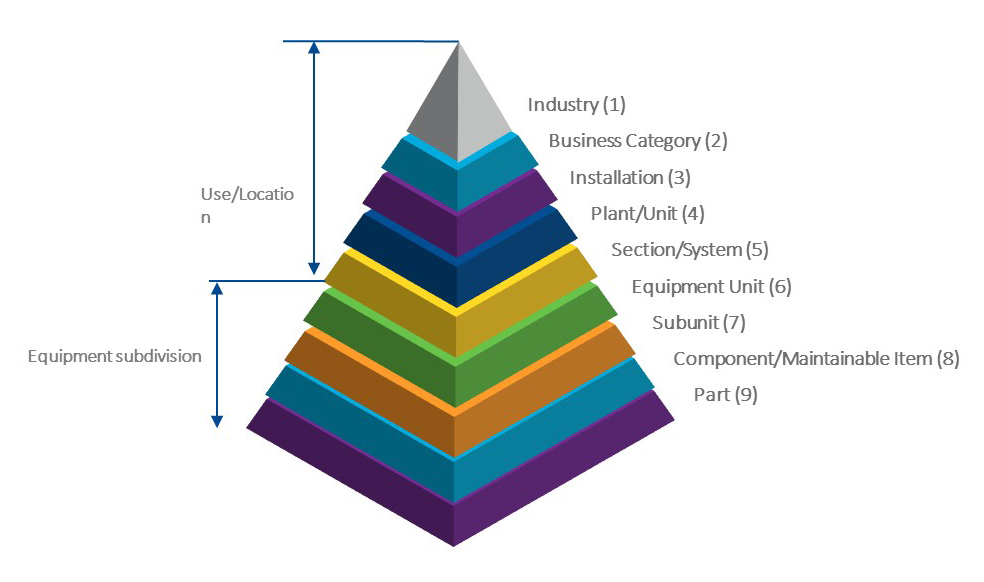
ISO 14224 standard provides a comprehensive basis for collecting equipment reliability and maintenance data, including:
- Equipment limits
- Equipment / component taxonomy
- Hierarchical classification
ISO 14224’s hierarchy breakdown recommendation
Below is an example of standardized, accurate asset hierarchy for a paper mill:
- Level 1 – Factory
- Level 2 – Areas: paper mill, converting, installations…
- Level 3 – Systems: pulp dissolving, internal breaking, pulp mixing, paper machine, effluent treatment, water supply, compressed air…
- Level 4 – Equipment or subsystem
- Levels 5 to 9 – Assemblies and sub-assemblies as required
How Well-Structured BOMs Improve CMMS Performance and Maintenance Efficiency
A Bill of Material (BOM) is a structured list of the components that make up a technical object or an assembly. Often an equipment’s parts list. BOMs can also include other data such as supplier details, warranty information, or additional documentation relevant for maintenance and operations.
There are 2 types of BOMs
- OEM BOM – Original Equipment Manufacturer BOM
- Includes all assemblies and parts used in the manufacture of the equipment
- MRO BOM – Maintenance Repair Operations BOM
- Includes all parts and portable items likely to be required during maintenance and servicing of the equipment, as well as other data that may support maintenance activities.
Example of an MRO BOM on a paper machine roll:

While building BOMs in a CMMS, it is imperative to apply rules of data standardization to ensure consistency, quality, and usability across systems. These rules include but are not limited to:
- Class
- Attributes
- Manufacturer, MFR P/N…
- Standard Description
Example of optimized and standardized BOMs:
- OEM Description: SPHERICAL ROLLER BEARING 23148 CCK/C083W33
- CMMS Description: BEARING SPHERICAL 240 MM BORE 400 MM OD 128 MM WIDTH TAPERED STEEL CAGE
Establishing Robust Data Governance for Asset Master Data
Establishing robust data governance for asset master data is fundamental to achieving reliable, accurate, and consistent asset information across your organization. In asset-intensive industries, where enterprise asset management depends on trusted data, a strong master data governance framework ensures that every piece of asset data, from fixed assets to intangible assets, is managed with precision and integrity.
Master data governance involves setting clear policies, procedures, and standards for managing asset master data throughout its lifecycle. This includes defining key attributes, establishing data ownership, and implementing controls to maintain data quality, security, and compliance. A data steward plays a crucial role in validating and approving asset master data changes, ensuring data quality and compliance. By embedding these practices into your asset information management processes, you create a foundation for effective asset management and data-driven decisions. A comprehensive master data management strategy is essential to guide all related activities, including the identification and management of each master data entity, such as equipment, locations, and suppliers, which often span multiple domains.
Centralized data governance is especially critical for organizations operating at scale or across multiple business units. Asset data often crosses organizational departments, making it challenging to integrate data from different organizational departments and systems. By consolidating asset data from multiple sources, including various source systems, into a single source of truth, companies can prevent duplicates, eliminate inconsistencies, and ensure that all business applications and systems rely on the same data. This centralized approach not only streamlines business processes but also supports compliance requirements and enhances supply chain efficiency. The goal is to create and maintain authoritative master records and establish a single master record for each asset.
Implementing robust data governance processes, such as data cleansing, data validation, and data normalization, further improves data quality. Data cleansing removes outdated or incorrect information, while validation ensures that asset data meets defined standards and business rules. Normalization standardizes data formats, making it easier to integrate with other systems and MDM software solutions, and ensures the same data is maintained across all systems. Data lineage should be tracked to provide transparency and accountability, allowing organizations to trace changes and ensure data integrity over time.
The benefits of strong asset master data governance extend throughout the organization. With high-quality, consistent asset data, businesses can make better decisions, reduce operational costs, and maintain compliance with industry regulations. Managing data effectively supports operational excellence and compliance. Maintaining reliable customer information and accurate customer records within asset master data is also essential for compliance and operational efficiency. Master data is used to describe transactions involving assets, such as maintenance or transfers, supporting business process consistency and integrity.
Ultimately, investing in master data management and governance empowers organizations to unlock the full potential of their CMMS, drive operational excellence, and deliver greater value to customers and stakeholders.
The benefits down the line
- Maintenance strategies: accurate and complete asset master data in a CMMS paves the way for world-class preventive and predictive
- Maintenance programs. It delineates maintenance requirements and schedules for each asset, enabling organizations to extend the equipment’s operational lifespan.
- Cost control: Asset master data is indispensable for controlling maintenance costs, offering vital insights for budgeting and resource allocation. Understanding the maintenance history, repair frequency, and expected asset lifespan enables informed decisions regarding budget allocation.
- Work orders management: Work Orders are the heart of any CMMS. They define the tasks that need to be performed on assets, assign responsibilities, and establish deadlines. Precise asset master data forms the bedrock for generating these work orders.
- Reporting and Analysis: a CMMS serves not only to track maintenance activities but also as a potent tool for reporting and analysis. Quality asset master data facilitates data-driven decision-making and performance analysis. Organizations can generate comprehensive reports on various aspects of maintenance, including asset performance, maintenance costs, and workforce efficiency.
- Inventory Management: effective inventory management is a linchpin of maintenance operations. Asset master data includes information about spare parts, encompassing details such as part numbers, quantities, and supplier information. This data is vital for efficient spare parts and inventory management. Accurate inventory data enables organizations to minimize stockouts by ensuring that the right parts are available when needed. Simultaneously, it helps avoid excess inventory that can tie up capital and storage space.
- Regulatory compliance: documenting compliance requirements and integrating them into the CMMS enables better tracking and management of compliance efforts, reducing the risk of non-compliance issues that could result in fines or penalties.
- Vendor Management: quality asset master data enables an organization to consolidate vendor relationships.
- Knowledge Transfer: asset master data also serves as a vital tool in knowledge transfer by documenting maintenance procedures and historical data, a critical asset for training new staff, ensuring consistent maintenance practices, and preserving institutional knowledge.
What to consider when embarking on an asset master data optimization project?
- What is the involvement of the manufacturer?
- Do they build hierarchy and part list
- Do you have a template to import the hierarchy and parts in the CMMS
- Do you have internal standard for :
- Creating Functional Location
- Creating equipment
- Creating BOM
- Creating Parts
- Do you have an internal team to build hierarchy?
- What is the involvement of your selected / local supplier?
- Do you have a corporate parts library?
- How detailed you want to build the hierarchy?
Conclusion
To effectively manage master data and ensure long-term data quality, it is essential to implement structured asset management processes. Leveraging data management solutions and master data management software helps organizations centralize, govern, and optimize asset master data.
By adopting master data management solutions, companies can streamline the process of managing master data, improve data consistency, and support digital transformation initiatives. Choosing the right solution is key to maintaining accurate and reliable asset information across the enterprise.
Asset master data forms the bedrock of successful CMMS operations. It ensures maintenance data accuracy, facilitates effective asset management, supports preventive maintenance, and controls costs. Furthermore, it ensures precision in work orders, empowers informed decision-making, streamlines inventory management, ensures compliance, supports vendor management, and facilitates knowledge transfer.
To maximize the potential of your CMMS and reap its benefits, investing time and resources in developing and maintaining high-quality asset master data is not an option, but a necessity. Organizations that prioritize this foundational aspect will be best positioned to optimize their maintenance processes and achieve their operational goals, deliver greater value to customers and stakeholders, and enable better customer experience through accurate customer data and the delivery of value-added services such as real-time monitoring, maintenance, and customer support.

Yoann Urruty, Eng., CMRP
Director of Technologies – Spartakus Technologies
[email protected]