
The 5 Core Components of an Effective Asset Performance Management System
/
read

If you’ve spent time on a plant floor, you already know the reality: equipment doesn’t fail on a convenient schedule. A pump goes down at the start of a shift. A compressor trips on a Friday afternoon. A critical conveyor shows signs of wear three weeks after it was supposed to be inspected, if anyone was tracking it at all.
Asset Performance Management (APM) exists to close that gap. Not with promises of zero downtime or perfect prediction, but with something more durable: a systematic approach to understanding how your assets behave, what they need, and how to act before problems become production losses.
But APM means different things to different vendors, and different things to different plants. Walk into any industry conference and you’ll hear the term applied to everything from a CMMS dashboard to a multimillion-dollar AI platform. That ambiguity isn’t just confusing; it gets in the way of actually improving reliability.
This article cuts through that. We’ll walk through the five core components that define an effective APM system, the pieces that actually move the needle in real industrial environments. Whether you’re evaluating APM software, trying to build an internal business case, or just trying to understand what your existing tools do and don’t cover, this is your grounding document.
What Is Asset Performance Management, Really?
Asset Performance Management is a discipline, not a product. At its core, APM is the structured practice of managing the health, reliability, and performance of physical assets over their operational lifecycle. The goal is to maximize uptime, reduce unplanned failures, and optimize the cost of keeping equipment running.
APM software is the toolset that supports that practice. Good APM software helps you collect data, detect problems early, manage work effectively, and learn from past failures. But software alone doesn’t create reliability. It has to be matched with the right processes and — critically — the people who know how to use it.
The most effective APM systems share five foundational components. Each one is necessary. None of them works in isolation.
Component 1: Asset Data Foundation
You can’t manage what you haven’t defined
Every credible APM system starts here: a clean, structured, complete record of what you have. That means your asset hierarchy and Master Data (equipment, functional locations, criticality ratings, maintenance history, and technical specifications) all organized in a way that reflects how your plant actually operates.
This sounds unglamorous. It is unglamorous. But it’s also where most APM implementations quietly fall apart. Organizations rush toward predictive analytics or advanced dashboards without building the data foundation those tools depend on. The result is a system that looks impressive in a demo and underdelivers in the field.
What a solid asset data foundation includes:
- Asset hierarchy that mirrors operational structure (units, systems, equipment, components)
- Criticality ranking based on consequence of failure — safety, production impact, cost to repair
- Accurate bill of materials and spare parts linkage
- Historical work order data, failure records, and maintenance costs tied to specific assets
- Equipment attributes: manufacturer, model, install date, expected lifecycle
Component 2: Condition Monitoring and Sensor Integration
Real-time visibility into how your assets are actually performing
Condition monitoring is the mechanism that tells you how your equipment is behaving right now, before a failure event, not after. It’s the difference between reacting to breakdowns and proactively managing health.
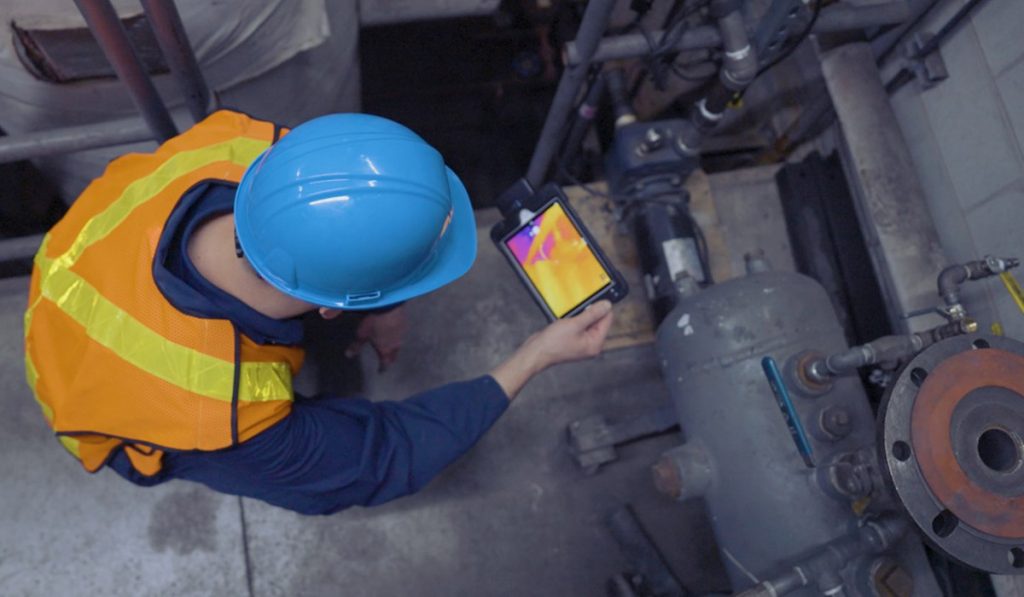
Modern APM systems integrate data from multiple monitoring streams: vibration analysis, temperature, oil analysis, ultrasound, infrared thermography, and process data from your DCS or historian. Each stream tells you something different. The skill is knowing which technologies apply to which failure modes on which assets.
Common condition monitoring technologies and what they detect:
- Vibration analysis: bearing wear, imbalance, misalignment, looseness in rotating equipment
- Thermography: electrical hot spots, heat exchanger fouling, refractory degradation
- Oil analysis: lubricant degradation, contamination, early-stage wear debris
- Ultrasound: compressed air and steam leaks, early bearing defects, valve passing
- Process data monitoring: flow, pressure, temperature trends that deviate from baseline
The integration challenge is real. Most plants have multiple data sources, some automated, some manual, operating in silos. Effective APM software consolidates these feeds into a unified view, flags anomalies against established baselines, and enables technicians to see developing issues before they cross a critical threshold.
Worth saying plainly: more sensors don’t automatically mean better reliability. A plant that installs continuous online monitoring on every piece of equipment without a process for reviewing and acting on the data has spent money on noise. Condition monitoring is only as valuable as the response it triggers.
Component 3: Reliability-Centered Maintenance Strategy
The right maintenance task, applied to the right asset, at the right interval
Condition monitoring tells you what’s happening. A maintenance strategy determines what you do about it, and equally important, what you don’t do.
A core function of effective APM is managing maintenance strategy: the set of tasks, intervals, and methods applied to each asset to preserve function and prevent failure. Without a structured approach, maintenance programs drift toward compliance theater: PMs that get completed on time but don’t prevent the failures that actually cost you production.
What maintenance strategy management covers:
- Failure Mode and Effects Analysis (FMEA) to identify likely failure modes and their consequences
- Task selection based on the specific failure modes each PM is designed to address
- Interval optimization — not too frequent (wasteful), not too infrequent (risky)
- Clear alignment between condition-based triggers and time-based tasks
- Review cycles to update strategies as asset history and operational context evolve
This is where Reliability-Centered Maintenance (RCM) methodology lives. RCM provides a structured framework for making defensible decisions about what maintenance to do and why. Not every organization will run a full RCM analysis on every asset. But the logic of RCM, starting with function, identifying failure modes, and selecting tasks that address those modes, should inform how any serious APM program builds and manages its strategy library.
APM software supports this by linking strategies to assets, tracking compliance, and surfacing performance data that tells you whether your maintenance approach is working. Over time, that feedback loop is what allows you to improve — to stop doing things that don’t add value and put more effort where it matters.
Component 4: Work Management and Execution
Reliability only happens if the work gets done, and done right
The first three components focus on identifying what needs to happen. Work management is where it actually happens. Or doesn’t.
Effective work management in an APM context means more than processing work orders. It means managing the full lifecycle of maintenance work: planning, scheduling, executing, and closing out with the data you need to support future decisions.
The key elements of work management in APM:
- Work identification: condition alerts, operator rounds, inspection findings, and scheduled PMs all flow into a unified work intake process
- Planning: right parts, right tools, right procedures identified before the work starts
- Scheduling: work sequenced and coordinated with operations, with appropriate priority based on asset criticality and failure risk
- Execution: field-level guidance that ensures tasks are completed consistently and completely
- Completion documentation: failure codes, findings, parts used, time spent, all captured at the point of work
That last point matters more than most organizations realize. The quality of data captured at work order closure is the raw material for failure analysis, KPI reporting, and strategy improvement. Technicians who skip failure coding or leave completion notes blank aren’t just creating administrative gaps, they’re breaking the feedback loop that allows the reliability program to learn and improve.
Modern APM software increasingly supports this with mobile work execution tools: digital work orders accessible on a tablet or smartphone, step-by-step task guidance, parts confirmation, and structured data capture at the point of work. Adoption of these tools is a real change management challenge, but the payoff is a consistent, complete record of what was done and what was found.
Component 5: Analytics, Reporting, and Continuous Improvement
Turning maintenance data into decisions
The first four components generate data. This component turns that data into insight, and insight into action. Without it, you have a well-documented maintenance operation that isn’t necessarily getting better.
APM analytics serve two distinct purposes: operational visibility and strategic learning. Operational visibility means knowing, in near real time, what’s breaking, what’s overdue, what’s trending toward failure, and where your maintenance resources are being consumed. Strategic learning means analyzing patterns across assets, failure modes, and time to understand why things fail and how to prevent recurrence.
Core analytics capabilities in effective APM systems:
- Equipment reliability metrics: MTBF, MTTR, OEE contributions, failure rate by asset class
- Maintenance cost analysis: cost per unit of production, PM compliance, backlog aging
- Bad actor identification: the top-spending, most-frequently-failing assets that deserve focused attention
- Failure analysis: RCA workflows tied to actual failure records and work history
- KPI dashboards tailored to different audiences, plant floor, operations, reliability, leadership
The analytics component is where APM software vendors often make the biggest promises, and where real-world results most often disappoint. Predictive analytics, machine learning, and AI-based anomaly detection are genuine capabilities in mature APM platforms. But they require clean data (Component 1), integrated monitoring feeds (Component 2), and organizational discipline around data capture (Component 4). Without those foundations, advanced analytics produce noise, not signal.
Start with the basics. Consistent failure coding and failure analysis will yield more reliability improvement in the first two years of an APM program than any machine learning model — because they create the organizational habit of asking why and acting on the answer.
How the Five Components Work Together
Each component is necessary. None is sufficient on its own.
Asset data without condition monitoring is a static inventory. Condition monitoring without a maintenance strategy generates alerts that go unaddressed. A maintenance strategy without disciplined work management is a document that doesn’t translate to field behavior. Work management without analytics doesn’t learn from its own experience. And analytics without clean underlying data produces conclusions you can’t trust.
The value of an APM system, and the ROI that justifies the investment, comes from the integration of all five. When a condition-monitoring alert triggers a work order that is planned, executed, and closed with complete failure data, which feeds into the next maintenance strategy review, you have a reliability system that compounds improvement over time.
That integration is what separates organizations that use APM software from organizations that have built an APM capability.
Evaluating APM Software: What to Look For
If you’re assessing asset performance management software, the five-component framework gives you a useful lens. For each component, ask:
- Asset Data: Does the platform support a configurable asset hierarchy? How does it handle data migration from existing CMMS or ERP systems? Can you define and enforce criticality frameworks?
- Condition Monitoring: What data sources does it integrate, historians, IoT sensors, manual route data? How does it handle alert configuration, thresholds, and noise reduction?
- Maintenance Strategy: Does it support RCM-based strategy development? Can you link failure modes to specific PM tasks? Does it track strategy compliance and provide performance feedback?
- Work Management: What’s the mobile experience for field technicians? How does it handle planning and scheduling? What structured data does it capture at work order closure?
- Analytics: What does the out-of-the-box reporting cover? How customizable are dashboards? Does it support failure analysis workflows and the identification of bad actors?
Beyond features, pay attention to implementation support and adoption. The best APM software in the world underdelivers if the organization doesn’t have the process discipline and frontline adoption to feed it good data and act on what it surfaces. Vendor partnerships that include change management support, frontline training, and execution coaching consistently outperform deployments that treat APM as a pure technology implementation.
Getting Started: A Practical Path Forward
If your organization is early in the APM journey, the path forward doesn’t require a comprehensive platform implementation on day one. Start with what you have and build deliberately.
A pragmatic sequence:
- Audit your asset data. Fix your hierarchy. Complete your criticality rankings. The rest of your program depends on this foundation.
- Identify your top bad actors. Don’t wait for a perfect analytics platform. Pull your maintenance cost data and unplanned failure records now. The top 10 assets deserve immediate focused attention.
- Formalize your failure coding. Even if you’re using a basic CMMS, structured failure data is the raw material for everything that comes after.
- Layer in condition monitoring where it has clear ROI. Start with rotating equipment on critical systems. Prove the value before expanding.
- Define what “good” looks like before you buy software. Know which problems you’re solving, which metrics you’re targeting, and what behavior changes you expect from the field.
APM is a long-haul discipline, not a project with an end date. Organizations that approach it with that mindset, and with the patience to build each component properly before moving to the next, are the ones that build reliability into how their operations actually run, not just into their software subscriptions.
Final Thought
The plant floor doesn’t reward theoretical frameworks. It rewards execution. Asset Performance Management, done right, is a system that helps the people who keep equipment running do their jobs better, with better information, better tools, and better support.
The five components described here aren’t a vendor checklist. They’re the building blocks of a reliability capability that your team can own, operate, and improve over time. That’s the standard worth building toward.

Raphael Tremblay,
Spartakus Technologies
[email protected]